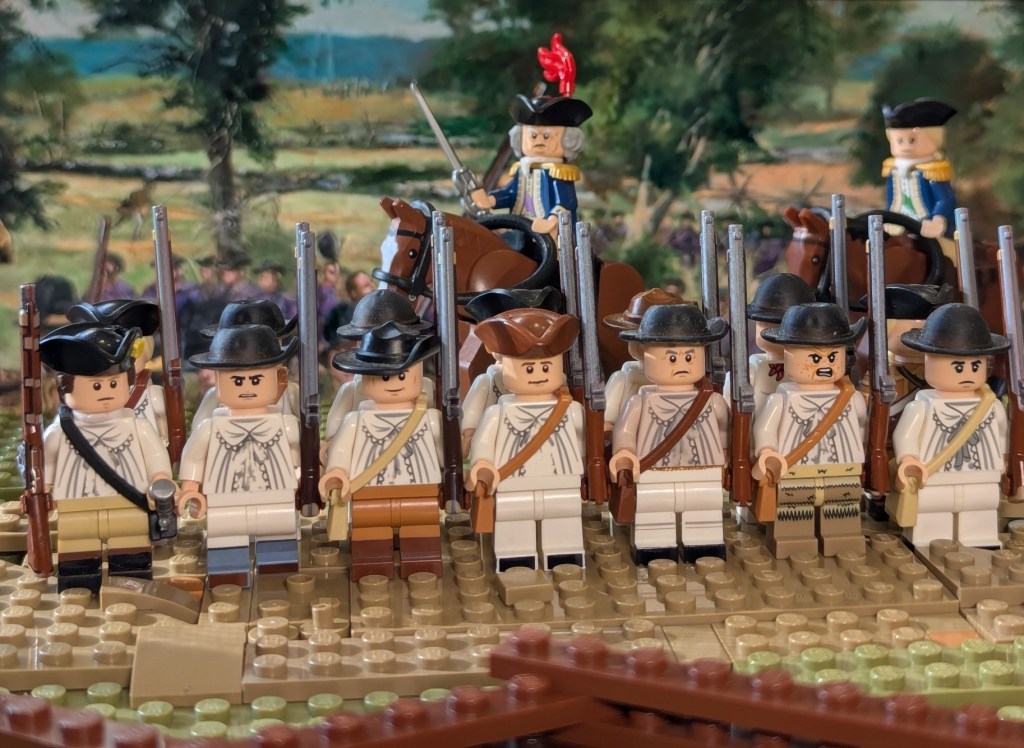
250 years ago today, Sept 16, 1776, a more united Continental Army held and even pushed back against the British army on Manhattan Island at Harlem Heights.
Just three days earlier, the 3rd Virginia Regiment had arrived on Manhattan after a long march from Virginia to join Washington’s army. They were the first of the Virginian Continental Regiments to join the army that would serve in the war (though of course not the first Virginians as that honor was held by General Washington himself and shortly thereafter Daniel Morgan’s rifle company). Captain John Chilton, a 38-year-old farmer from Fauquier County, wrote home that “great joy was expressed at our arrival and great things expected from the Virginians, and of consequence we must go through great fatigue and danger.” He continued that every man in the company was “determined to fight to the last for their country; every soldier encouraging and animated his fellow.”
Great things were indeed expected of the Virginians. These new arrivals to the Continental Army were from the southernmost colony/state up to that point to send troops to join the army. The only other state further south that would eventually send regiments to join the army, North Carolina, wouldn’t arrive for another year (being occupied with engagements in the southern theater in 1776). Furthermore, by the end of the war, Virginia was second only to Massachusetts to contribute the most amount of troops to fight and was the only colony/state to send troops to all theaters of conflict on the continent (as far north as Canada, as far south as the Georgia-Florida border, and as far west as St. Louis/Illinois) to fight for The Cause.
On the morning of Sept 16, 1776, Chilton recalled, “we marched down toward [the enemy] and posted ourselves near a meadow having that to our front, [the Hudson] river to our right, a body of woods in our rear and on our left. We discovered the enemy peeping from their Heights over fencings & rocks & running backwards & forwards. We did not alter our positions. I believe they expected we should have ascended the hill to them, but finding us still, they imputed it to fear and came down skipping down towards us in small parties, at the distance of about 250 or 300 yards they began to fire. Our orders were not to fire till they came near, but a young officers (of whom we have too many), on the right fired and it was taken up from right to left. We made about 4 fires… During this 3 companies of Riflemen from our Regt, West’s Thorntons & Ashby’s with [Colonel Knowlton’s Connecticut] companies of Riflemen were flanking the enemy and had began a brisk fire on the right of [the British]. On this, [the British] began to retreat up the hill carrying off their dead & wounded, for we had galled them a little and then let me not forget the brave Marylanders who were below us and sustained the hottest fire and must have done the greatest execution as they kept a constant fire after we were ordered to reserve ours.”
“The enemy retreated about a quarter & a half when they were reinforced with men & cannon. We had but one field piece in the battle they had several. The battle began between 8 and 9 in the morning and lasted ‘till about 2… [I] am informed that we had about 20 killed & as many wounded. It is said that the enemy consisted of about 10,000 tho’ suppose they had not about 2 or 3,000 in the action we had not so many.”
The 3rd Regiment’s surgeon wrote afterward that, “our troops behaved in a manner that does them the highest Honor… Major Leitch was detached with the 3 rifle companies to flank the enemy. He conducted himself on this occasion in a manner that does him the greatest honor and so did his Party, till he received two balls in his belly and on in his hip… We had 3 men killed and ten wounded…. The wounded are not more than 40. Colonel Knowlton of the New England Rangers is the only officer killed [Major Leitch had not yet died from his wounds]… I must mention that the two Yankee Regiments who ran on Sunday [at Kips Bay] fought tolerably well on Monday and in some measure retrieved their reputation. This affair, tho’ not great in itself, is of consequence as it gives spirits to the army, which they wanted. Indeed the confusion was such on Sunday [from the rout from Kips Bay and New York City] that everybody looked dispirited. At present everything wears a different face.”
For Chilton’s full original letter be sure to check out the Virginia Museum of History and Culture!
Also I highly recommend the book ‘Virginia’s Continentals 1775-1778’ by Michael Cecere.
 Curator Kevin
Leave a comment